Researchers from the Max Planck Institute for Chemical Ecology demonstrate in a recent study that the life history of Drosophila busckii revolves around a toxic molecule, dimethyldisulfide (DMDS). The team has discovered that D. busckii is the first drosophilid species demonstrated to survive a known insect neurotoxin and could be developed further as a model to address questions of ecology and toxicology.
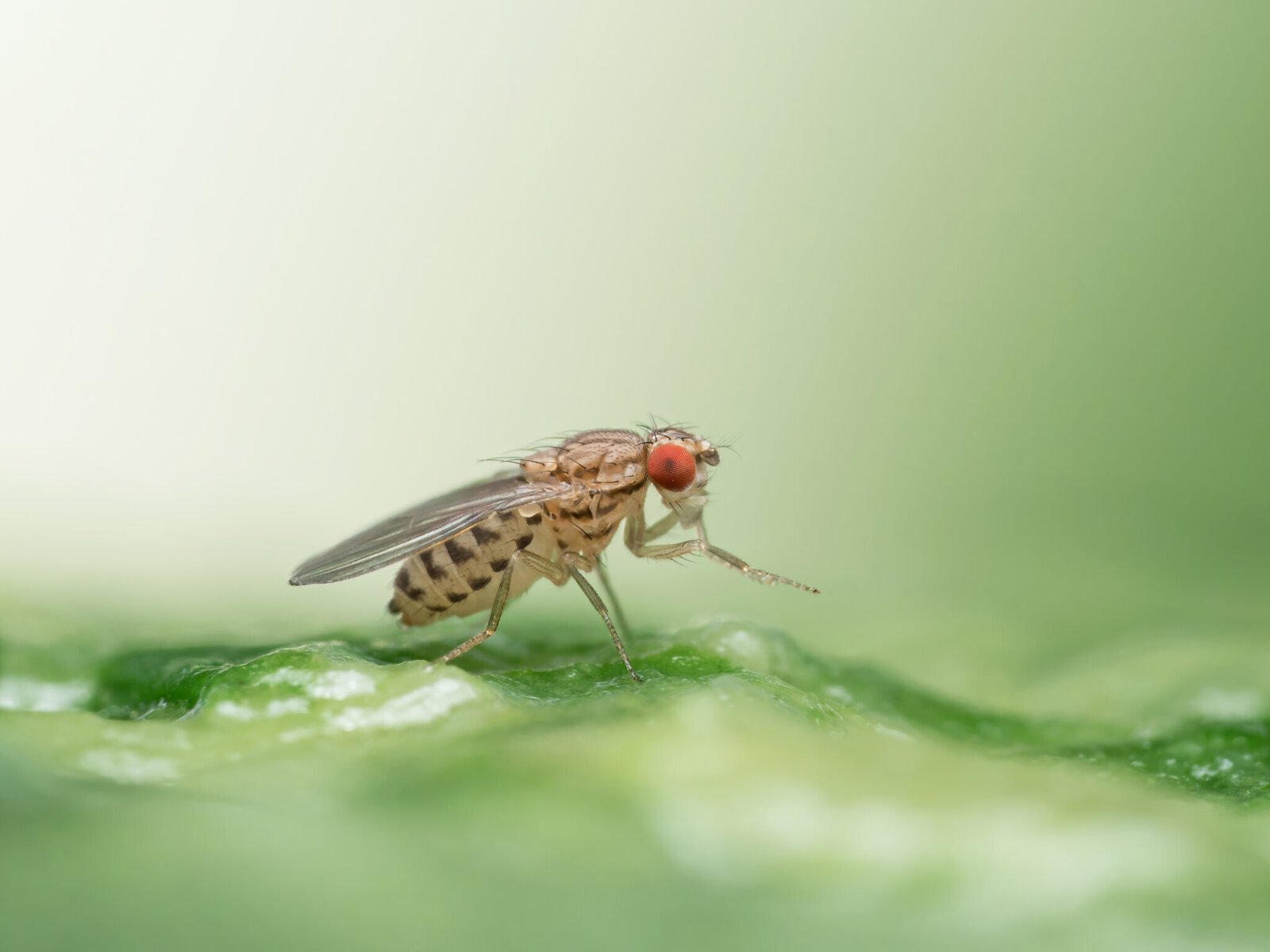
Imagine a kitchen that has been left untouched for a couple days — it’s a breeding ground for decaying vegetables — and it smells horrible, almost sulphurous. Smelling this would turn your stomach, but for a tiny insect that most of us have overlooked, this is an opportunity. For Drosophila busckii, a lesser-known cousin of the typical fruit fly, the repugnant smell acts as an invitation — through a chemical signal — to do what it does best: lay eggs and thrive when others perish.
This fly does not just exist in, but actually prefers the fumes of decay. How it does so is still being examined by scientists.
Although tiny, insects have developed a very elaborate communication system — not through sound or sight, but through chemistry. They thrive in a world that is largely governed by smells (olfaction): invisible signals drifting through the air that can guide insects to food, mates, safe places to lay eggs, and colonise and survive diverse ecological niches. Sometimes, this means evolving to thrive in a toxic environment, allowing for the utilisation of novel resources and avoiding competition over a single resource. Chemical ecology, in oversimplified words, is tapping into this ongoing communication to decipher its meaning and its basic principles. However, the mechanisms driving such rapid olfactory and tolerance adaptations remain poorly understood beyond well-known model species such as Drosophila melanogaster and its close relatives. Most of us have seen D. melanogaster, the small flies that are present in our kitchen around fruits. However, we fail to appreciate that the Drosophila genus contains more than 1500 species, while only up to ten have been studied in order to understand the chemical interactions between their corresponding hosts.
One such unexplored species is D. busckii. This species, also found in India, is known to breed from rotting vegetables, in contrast to its cousin species D. melanogaster, which has a strong preference for fermenting fruit. However, the olfactory basis of this adaptation was not studied before. Moreover, the sparse amount of literature suggested that the species could have developed an ability to tolerate toxic compounds emanating from rotting substrates.
This new study, published in Nature Communications, aimed to investigate just that, what exactly is attracting this fly (D. busckii) to the decomposing vegetables and how is it surviving, let alone thriving, under such extreme conditions?
Using an array of classical chemical ecology techniques such as analytical chemistry: Gas chromatography – mass spectrometry (GC-MS), electrophysiology (single sensillum recording) and behavioural bioassays, the team demonstrated that D. busckii prefers to breed from multiple rotting vegetables that emit large amounts of dimethyldisulfide (DMDS). Further, this fly also uses DMDS as an egg-laying cue and possesses a single class of olfactory sensory neurons (OSNs) in its antenna that are specifically tuned to detect even trace amounts of DMDS.
In contrast, no known type of OSNs in the antenna of D. melanogaster responds to DMDS, suggesting DMDS sensing has evolved specifically in D. busckii. DMDS, however, is toxic to many insects. Exposure to DMDS resulted in 100% mortality of several fly species, including D. melanogaster, within two hours of exposure. A particularly striking discovery in D. busckii’s case is that it has evolved resistance to DMDS and completed its life cycle on high amounts of DMDS. Eventually, a series of supporting experiments led to a hypothesis that this resistance is likely mediated by adaptive insensitivity of the cytochrome c oxidase (COX; the last subunit of the mitochondrial electron transport chain), representing a rare instance of natural resistance evolution in an ecological context. It could further be hypothesised that this unique ability in D. busckii might open up access to unique resources that are void of any competition.
In summary, this study firmly demonstrates the potential of D. busckii to be established as a model species to investigate key phenomena in chemical ecology, including host specialisation and niche partitioning. Moreover, COX is also a site targeted by other highly toxic gases such as carbon monoxide and hydrogen cyanide. Therefore, D. busckii could also potentially serve as a model to understand adaptations to thrive in toxic environments. This study is an excellent example of the power of classical chemical ecology techniques to systematically investigate unexplored, non-model insect species — an area where India, with its vast and diverse fauna, holds immense untapped potential.