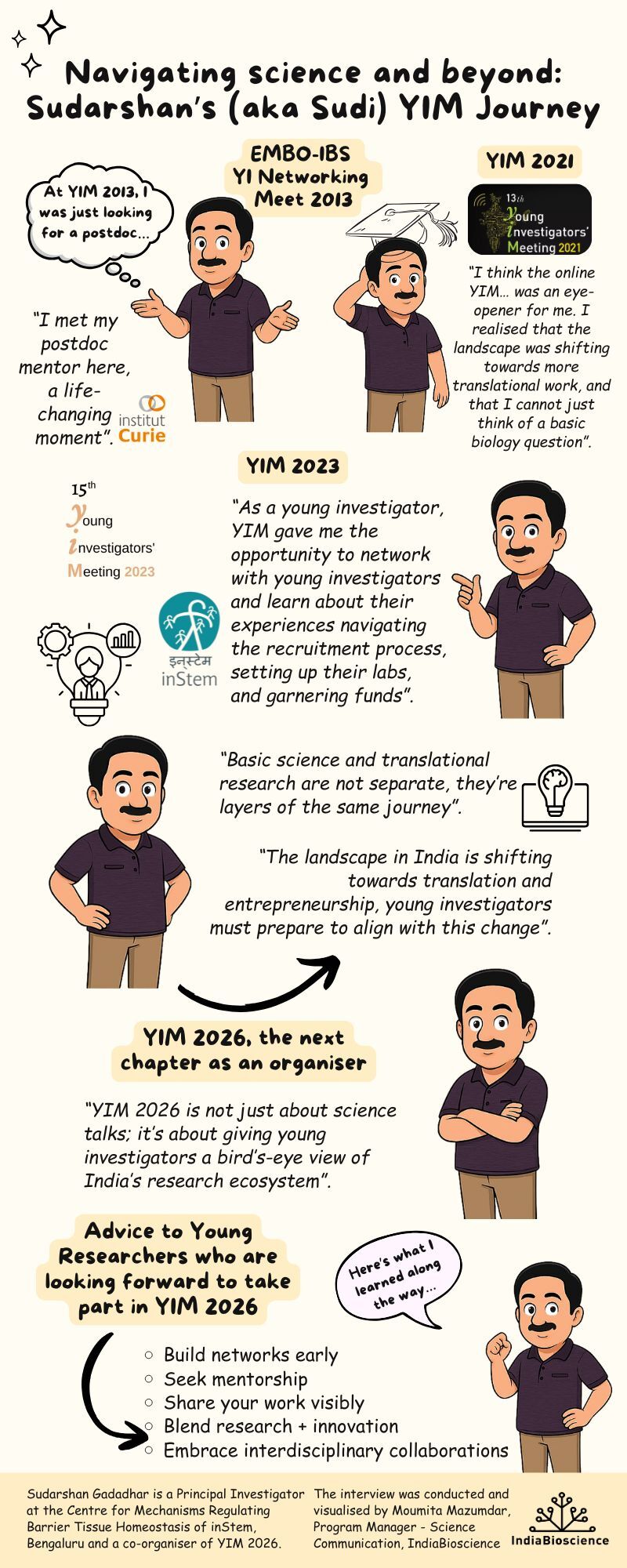
When Sudarshan Gadadhar first attended the Young Investigators’ Meeting (YIM), he came in with a lot of questions. “I was not sure about where I was heading, about the kind of science I wanted to do, and whether I was ready for the challenges of independent research”, he recalls. YIM gave him more than answers; it provided perspectives, peers in similar transitions, and mentors who had walked the path before.
Those conversations stayed with me. YIM was not just about opportunities; it was about finding a sense of community”.
Beyond science alone
From the beginning, Sudarshan believed that science is not a solitary act. “You can’t grow in a silo. Collaboration and community are not add-ons; they are essential”, he says. This ethos shaped his early years as an independent researcher, as he sought collaborations that pushed him beyond his comfort zone. “Whether it was reaching across disciplines or learning how to communicate science beyond academia, I always wanted the work to have impact”.
For him, impact is not only in publications or grants, but in ideas, connections, and opportunities for others.
Ask questions, build networks, reflect often, and remember that growth in science is always about more than science alone”.
Balancing challenges
The transition from postdoc to independent scientist was not without strain. “At first, I felt the weight of everything: research, teaching, administration, expectations from students, and my own ambitions”, he says. He learned to reframe it as an opportunity for growth.
You have to let go and build trust with your students as they take ownership of the scientific question. Handing over the bench work isn’t easy, but it’s essential”.
Mentors, peers and inspiration
At YIM and beyond, mentors played a critical role. Sudarshan values both the senior scientists who offered advice and the peers who fostered a sense of being part of a community. “Networking is not about collecting contacts. It is about meaningful conversations that can open up new directions. Even a single thoughtful piece of advice, or a nudge from a mentor, can change the way you see your career”. He adds, “I want young scientists to know they are not alone, that there are people who will support them, even if only with a small word of encouragement”.
Looking ahead
Years after first attending YIM, Sudarshan is now back as one of the organisers. He sees the meeting evolving alongside his own career. “When I first attended, I was looking for directions. Today, YIM is not only about research opportunities, but about entrepreneurship, collaborations across science, industry and clinics, mentorship, and networks that extend beyond science”.
His advice to participants:
Come with curiosity. Don’t just look for jobs or collaborations. Look for ideas, look for mentors, and look for the bigger picture of what kind of a scientist, and person, you want to become”.