A recent breakthrough in China, where a diabetic woman regained insulin production through a stem cell transplant, highlights India’s urgent need to reflect on its own human stem cell research. Despite global advances, India lags behind in innovation and infrastructure. A nationwide survey now seeks to uncover why — and how to fix it.

A 25-year-old diabetic woman in China made headlines last year after receiving a transplant of stem cell-derived islet cells that restored her ability to produce insulin. For India, home to the world’s largest population of diabetics, this breakthrough calls for a reflection on the state of our own innovations.
Meanwhile, just last week, researchers at the San Diego – based company Qureator unveiled a tumour-in-a-dish model, complete with a network of blood vessels. This laboratory model mirroring human cancers paved the way for testing of new drug combinations in the clinic. It stands out as both ethically responsible (animal-free testing) and human-relevant, an approach that India fully endorsed in 2023.
Such stem cell research has been transforming the landscape of modern medicine ever since Nobel laureate Shinya Yamanaka showed nearly two decades ago that ordinary adult cells can be reprogrammed into highly adaptable stem cells.
And yet, India remains oddly silent on the clinical as well as laboratory fronts in this field. It is time to ask:
Why is India’s human stem cell research broken, and what will it take to fix it?
Where ideas found allies
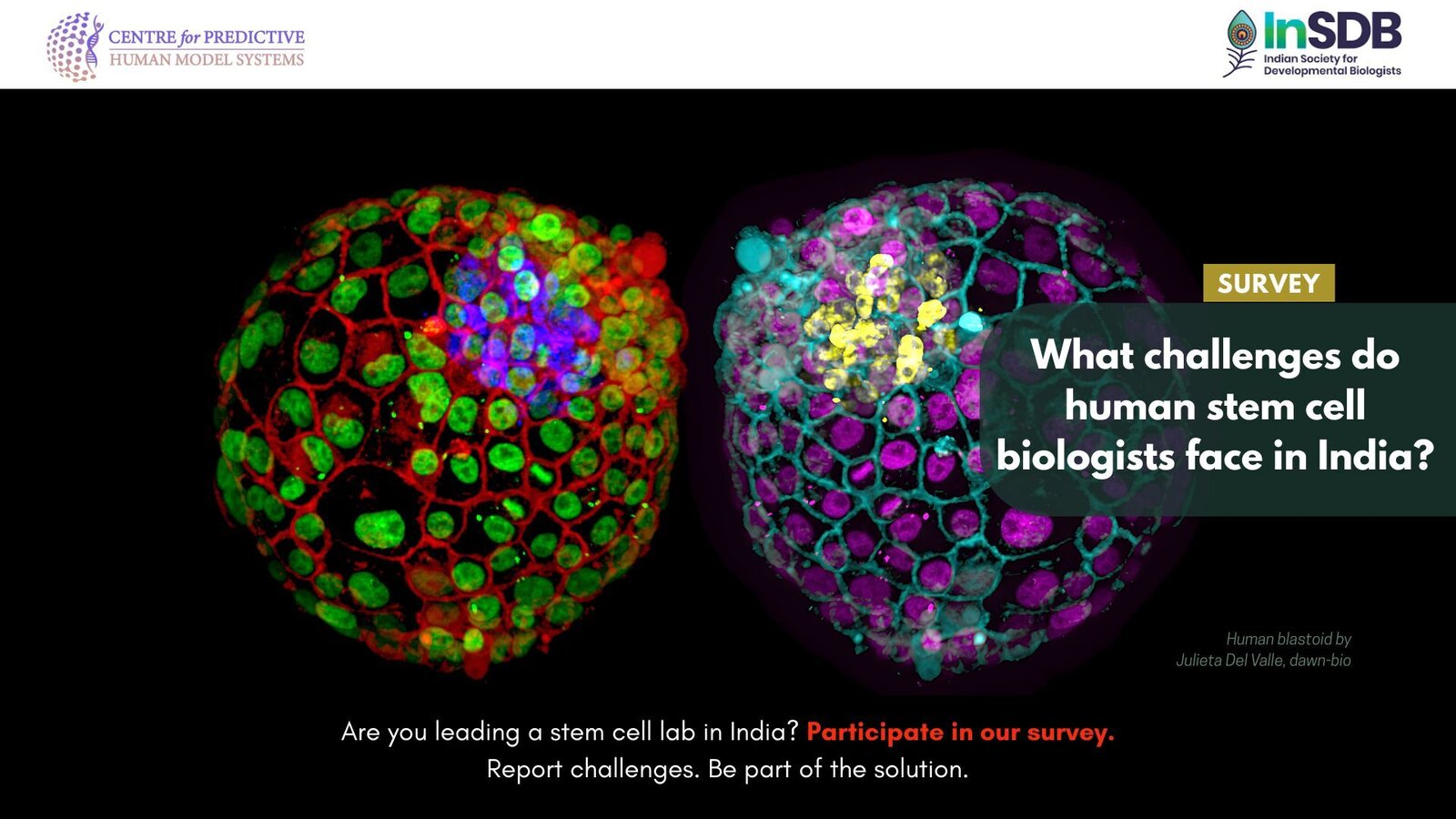
Frustrated by the lack of momentum in India’s human stem cell research, Manasi Srivastava—a scientist and alumna of CSIR-CCMB — approached me to explore the possibility of a collaboration to better understand the issue. At the Centre for Predictive Human Model Systems, where our goal is to translate fundamental research into better human health outcomes, I needed no convincing. Together, we designed a survey to capture the voices of human stem cell team leadsacross India, identifying challenges and potential solutions for the way forward (open from 6 October to 28 November 2025).
Soon after, the Indian Society for Developmental Biologists (InSDB), a large community of stem cell scientists, endorsed our vision. Ramkumar Sambasivan (IISER Tirupati) and Raj Ladher (NCBS-TIFR) offered us a platform to brainstorm and refine the survey findings at the upcoming InSDB meeting, in the presence of key stakeholders.
Uncovering what lies beneath
So, what do the early responses to the survey reveal?
A striking 88% of respondents said they face challenges in conducting human stem cell research in India, and 79% reported grappling with more than one obstacle.
At the top of the list is the lack of access to reliable, locally-made, and customisable laboratory supplies. Most robust vendors operate outside India, selling to Indian scientists only through distributors and on-demand orders. The result: higher costs and long delays that slow research to a crawl. Close behind are the absence of dedicated funding calls and limited access to human stem cells themselves.
Through it all, one sentiment emerged loud and clear: “India needs a national stem cell mission, and the time is now”.
Do you resonate? Add your voice, take the survey today.