In a new LinkedIn post, the CEO of the Anusandhan National Research Foundation (ANRF), Shivkumar Kalyanaraman, outlined how the foundation is evolving into India’s apex body for research, development, and innovation. Alongside strengthening core research grants, ANRF is preparing to operationalise ₹1 lakh crore Research, Development and Innovation (RDI) Fund, designed to channel patient capital into deep-tech, high-impact projects.

Disclaimer: This article is written in the author’s own personal capacity and not an official document of ANRF. This is meant to be a simplified overview of ANRF and RDI. All official communication should be from GoI web pages and documents. Any errors / mis statements in this article or elsewhere in social media by this author are the author’s alone. The author reserves the right to make any changes or withdraw any statements made. These should not be viewed as basis for current or future programs of ANRF (which are approved only by the ANRF Executive Council). Neither the author nor ANRF nor Govt of India will bear any liability for any impact directly/indirectly from any interpretation of what is written in this article.
Anusandhan National Research Foundation (ANRF) is a statutory body, presided by the Hon’ble Prime Minister of India, created by the ANRF Act 2023 as an apex organisation for research and innovation across all stakeholders (government, academia, industry/startups, labs, philanthropy, international etc). The organisation was notified in Feb 5, 2024, and the erstwhile Science and Engineering Research Board (SERB) was dissolved.
ANRF aims to catalyze the rise of India as a Research, Development and Innovation powerhouse. The idea of a National Research Foundation (NRF) in India had its genesis in the National Education Policy (NEP) 2020, Chapter 17. National Education Policy 2020 envisions a comprehensive approach to transforming the quality and quantity of research in India. Research and innovation at education institutions in India, particularly those that are engaged in higher education, is critical. To build on these various elements in a synergistic manner, and to thereby truly grow and catalyze quality research in the nation, NEP 2020 envisions the establishment of a National Research Foundation (NRF).
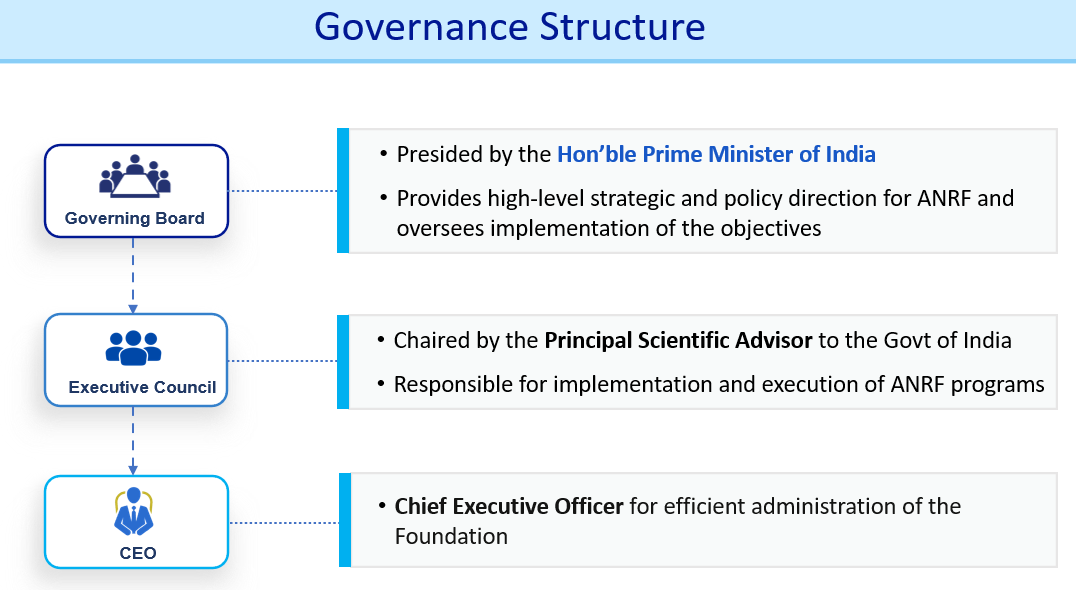
The governance structure of ANRF is a Governing Board (GB) Presided by the Hon’ble Prime Minister of India, an Executive Council (EC) chaired by the Principal Scientific Advisor (PSA) to the Govt of India, and the CEO who reports to the Executive Council. The Vice Presidents of the Governing Board are the Hon’ble Minister of Science and Technology and the Hon’ble Minister of Education. I am privileged to serve as the first full time CEO of ANRF, succeeding Prof. Abhay Karandikar who served as Interim CEO. DST is the administrative ministry for ANRF; but as a statutory body and apex organisation, ANRF serves stakeholders in all parts of the government in its focus areas. Secretaries/DGs of scientific departments, and selected ministries are members of the GB and EC.
What is ANRF Core ? What is RDI ? How are they Related?
Hon PM Narendra Modi ji on 3rd Nov 2025 announced the Rs. 1 lakh Crore RDI Scheme (https://lnkd.in/gGCvajBf ), anchored by DST and Operationalized via ANRF. Prof. Abhay Karandikar , Secretary DST, is the interim Executive Director of RDIF. DST has a RDI Cell, and a business unit called RDIF Business unit is being established in ANRF in close collaboration between the DST RDI Cell and ANRF teams. I would like to extend my congratulations and sincere thanks to DST and RDI cell for amazing work on RDI in record time. Key roles for hiring in the RDIF business unit will be announced shortly. Multiple outreach events (in Mumbai, Bangalore, Panchakula) have been held, and more is coming (Delhi, Hyderabad) as of Dec 7th, 2025. The deadline for the SLFM proposals is in January 2026.
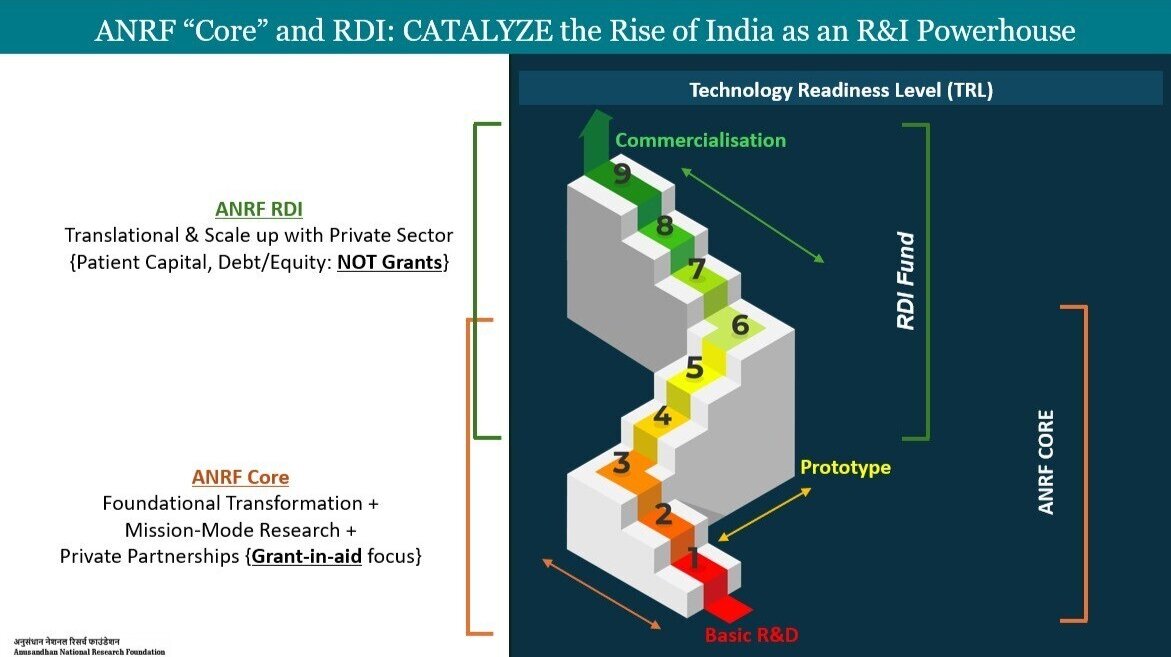
The picture below illustrates the complementary relationship between ANRF Core (grants) agenda and RDI Fund (patient capital, non-grants) agenda.
ANRF Core focuses on grants-in-aid to the research entities of India: academia, national research laboratories (NRLs), section 8s linked to these entities (not-for-profit entities which are bridges to industry or other stakeholders), and registered DSIR-SIRO research organisations, hospitals etc. In some of our programs we support other research done by entities like Darpan-registered NGOs, startups, MSMEs etc. At the moment, due to ANRF’s genesis in National Education Policy, we do not use our core budgets for the private sector grants.
Grants are used largely for academia, national research labs, section 8 and such entities (with some differences based upon programs) to de-risk and develop technologies at lower TRL levels (1−6). Broad based grant programs (eg: ARG, PMECRG) and mission mode grant programs (eg: MAHA EV, MedTech, 2D Materials, AI for Science/Engineering etc) fall in this category. ANRF directly is involved in entire program lifecycle (formulation, selection, monitoring, governance etc), assisted by external committees, etc.
The ANRF Act 2023 has an Innovation Fund structure, which along with co-funding from non-governmental entities (eg: philanthropy, CSR, family offices, diaspora, or corporate R&D) could be used to support a combination of industry, startups and academia/labs. In other words, the partnership beyond government is helpful beyond just expansion of budget, but also in supporting a wider variety of stakeholders, and driving greater productivity through collaboration and spillovers to the broader economy.
Therefore, ANRF invites the non-govt / private sector to partner holistically with us across the entire spectrum. Philanthropy / Foundations, Corporate CSR, R&D In Kind/Cash based engagements are examples of partnership on grants (ANRF Core) at scale which in turn forms a long-term pipeline for RDI (see below).
The Act also allows the creation of Special Purpose Funds (SPFs) for special purposes determined by GoI. One such ANRF SPF is the Research, Development, and Innovation (RDI) Fund of Rs. 1 lakh Crores.
RDI fund is aimed at the private sector, and TRL 4+ (translation & scaling). These are NOT grants (i.e. capital where the tax payer expects their money back). The capital may be patient (longer tenor), unsecured, loans/debt/equity or hybrid, and have differential cost of capital (IRR expectations, deferred coupons, some part convertible etc) compared to capital available today. The figure below gives an overview of the proposed overview of RDI Fund mechanism (and how it is distinct from the grant).
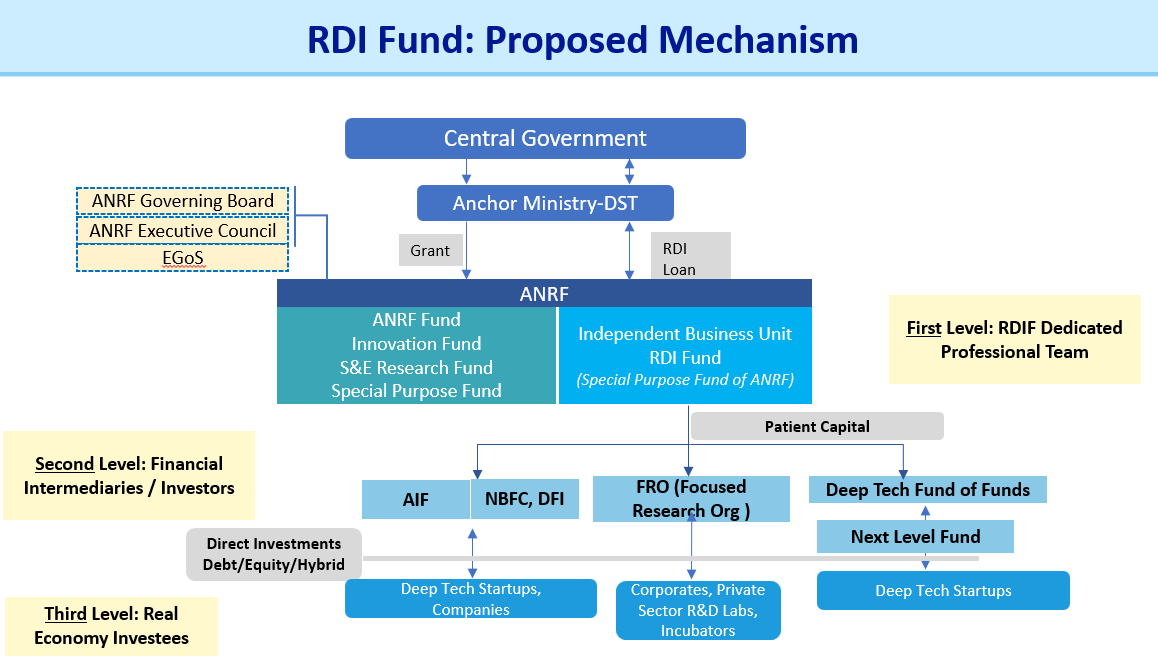
ANRF is a first level custodian (and NOT the decision maker on projects). So please do not approach ANRF directly with project proposals. ANRF is given the capital from Consolidated Fund of India via our Anchor Ministry DST, as a loan, specifically at 0% interest, 50 year tenor (note this does not mean end-projects get the money at these terms!).
ANRF Executive Council appoints second level fund managers (SLFMs) who in turn will design the appropriate financial instruments (debt, equity, hybrid etc) and allocate capital to eligible companies and projects. SLFMs can be AIFs, FROs, DFIs, NBFCs etc. In addition, corporate entities, GCCs may partner in the formation of AIFs (or SLFMs) as limited partners. Eligible entities must have management control by Resident Indians. Any conflict of interest must be made clear in applications.
Eligible entities may choose to apply on a project-basis to an appropriate SLFM. This RDI fund is NOT for routine R&D, and must be RDI-intensive R&D. These SLFMs (financial intermediaries) in turn make the capital allocation decisions to deploy this patient capital into specific RDI-intensive projects, companies passing on the patience and blended IRR into the real economy. There is a listing of Sectors and sub-sectors eligible for RDI on the website. These may be revised periodically by the ANRF Executive council, or by the Empowered Group of Secretaries (EGoS) chaired by the Cabinet Secretary
Note that RDI is NOT for academia, research labs etc. However, RDI will lead to a lot of indirect opportunities for technology translation, industry-academic collaboration and alumni engagement. RDI intensive (deep tech) startups spun out of academia will have more paths to market and funding via SLFMs. Further larger industry players, unicorns and MSMEs will look to academia / labs for deep tech technologies to license or partner on. They may also require ongoing backend partnerships for driving competitiveness in a world of RDI. This will drive demand for industry-academic collaboration. Academia/labs and technology transfer offices (TTOs) should re-imagine their roles to drive greater levels of translation and engagement in a world of RDI. For students, researchers, RDI will mean more jobs in the private sector beyond the academic / labs sector. We also envision the needs for research visitorships and increased value of Professors of Practice in academia in a world of RDI.
A multiplier of between 3X to 10X+ is expected as the fund capital is invested into the real economy across sectors. At a median of Rs. 4 – 5 lakh crore, RDI combined w/the grant investments of ANRF itself will drive a direct increment of 0.25% of GDP and catalyze a virtuous cycle of private R&D investments which could be much larger over time. As investments pay off, and the proceeds and gains will be re-cycled into catalyzing further R&D investments.
For more details on RDI (Rs 1 lakh Crore Fund): https://lnkd.in/gGCvajBf
- Brochure: https://lnkd.in/giKSvjbR
- Subsectors: https://lnkd.in/gVf2yyQu
- Implementation Guidelines: https://lnkd.in/gdjniKNm
- Notice Inviting Applications (NIA) for SLFMs: https://lnkd.in/gDqWefDU
- More details on RDI, Please Contact: https://rdifund.anrf.gov.in/contact.html
- Please also see Prof. Abhay’s posts: here and here
ANRF Core Grants Strategy
ANRF core lays the TRL 1 – 4 foundation for basic & fundamental research; and TRL 2 – 6 acceleration of applied research as a feeder into the larger RDI pipeline. ANRF targets this by a combination of a “horizontal” and “vertical” strategy outlined below.
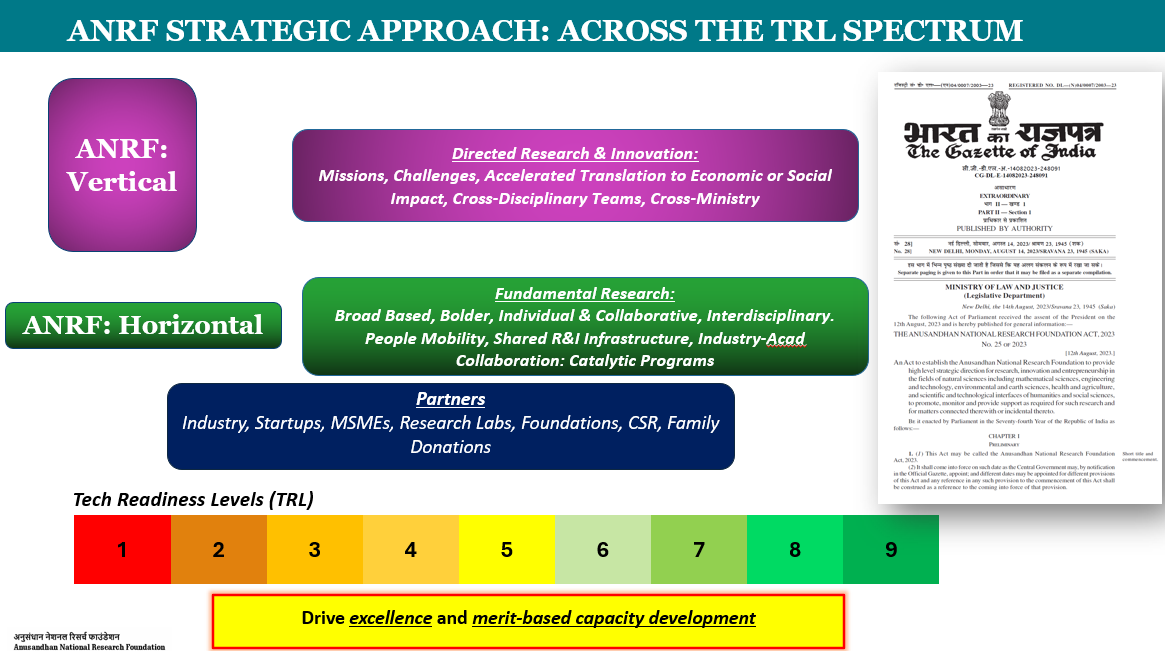
By “horizontal” we mean broad based research, smaller projects (larger number of awards), individual fellowships, where we don’t tell investigators what to do, and instead evaluate their bottom-up ideas via expert committees. ANRF also supports humanities and social sciences (including management sciences & policy studies) at the interface of science & technology. A good analogy for this is how the National Science Foundation (NSF) drives broad based basic research investments in the USA.
There has been some trepidation whether ANRF will only focus on translational research. On the contrary, we are increasing our investments in basic and fundamental research. Only that we are asking researchers to be bolder, ambitious and where appropriate, consider interdisciplinary collaboration and small teams for greater impact. Impact beyond publications is also an important aspect, which means that the researchers should do more to drive deeper dissemination of their work artifacts, creation of data sets, open software/IP as appropriate, collaborate with technology transition specialists. Retaining specialization in their core areas, while catalyzing deeper diffusion of research outcomes should be viewed more positively as normal course of expectations consistent with larger investments by society into the research enterprise. Einsteins do not have to transform into Elon Musks — they may remain Einsteins or Elon Musks, but only communicate with each other.
ANRF will also be driving greater emphasis on research capacity development across the country, sharing of infrastructure, and research visits to other collaborators / industry. Many steps are being taken to drive up ease of doing science, including support for international travel as standard, flexibility in recurring budget in individual-centric programs, simplified procurement policies with institution head approval, and the establishment of administrative nodal officers in every institution with corresponding linkages to ANRF nodal officers to move the administrative burdens away from scientific principal investigators.
A significant feature of ANRF is also its role in catalyzing earlier stage involvement of non-governmental partners across ANRF programs. All ANRF programs are open for co-funding (initially at a higher clip level top-down) by non-governmental sources. Industry & GCC may also collaborate with ANRF in other compelling ways, and in bottom-up manner as part of academic-led consortia in ANRF programs. This will also give a strong pipeline for RDI competitiveness for industry.
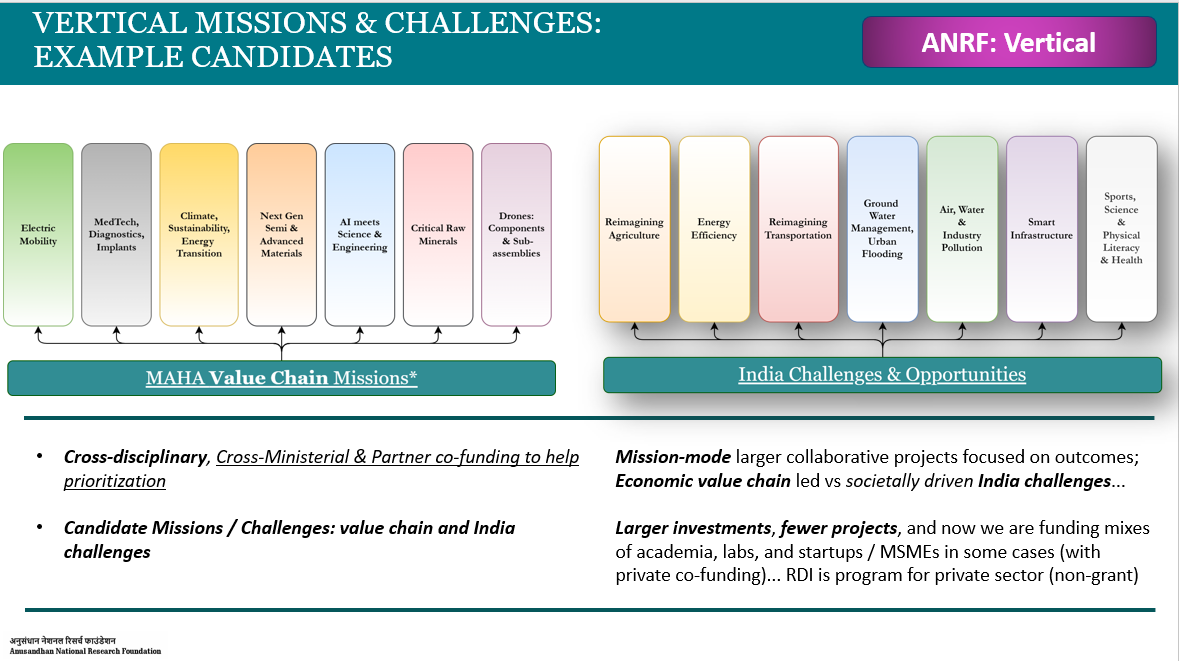
Vertical programs are more targeted programs, either driven by sectors / ecosystems / value chains to be accelerated, indigenous technology capability accumulation in critical sectors, or driven by technological innovation for societal problems. ANRF takes a “DARPA” style focussed approach to these, but appropriately tailored for each target sector. These programs are typically cross-disciplinary, cross-ministerial and ideally will also involve partnership with non-governmental partners (eg: foundations, companies etc), and involve collaborative teams / consortia involvement with some co-funding expected. These projects are monitored/managed more intensely, and governed towards impact, albeit with more mentoring, and ecosystem linkages explicitly engineered via support of project management units. ANRF is developing deeper institutional capabilities on program governance across all its programs.
The picture below gives some candidate programs either launched or contemplated. Note that the specific approach or even the possibility of launching any specific program is dependent upon whether co-funding partners emerge from within government or from non-governmental sources. An example is the ANRF MAHA MedTech program which is created by the partnership of ANRF, Indian Council for Medical Research (ICMR) and Gates Foundation as anchor partners. Later the Wadhwani Foundation has also expressed interest in supporting some of the projects. Similarly, the ANRF MAHA AI for Science & Engineering program involves partnership with MEITY, DRDO, Ministry of Earth Sciences, DBT and non-governmental partners including the Gates Foundation, Sarvam.ai and BharatGen. We have interest from multiple other partners interested in contributing to ANRF programs.
ANRF is rapidly establishing such “All of Government” and “All of Society” partnerships, and invites holistic thinking by non-governmental partners, including industry, international partners and contribute to current and future ANRF Programs. My doors are open for such conversations and partnerships.
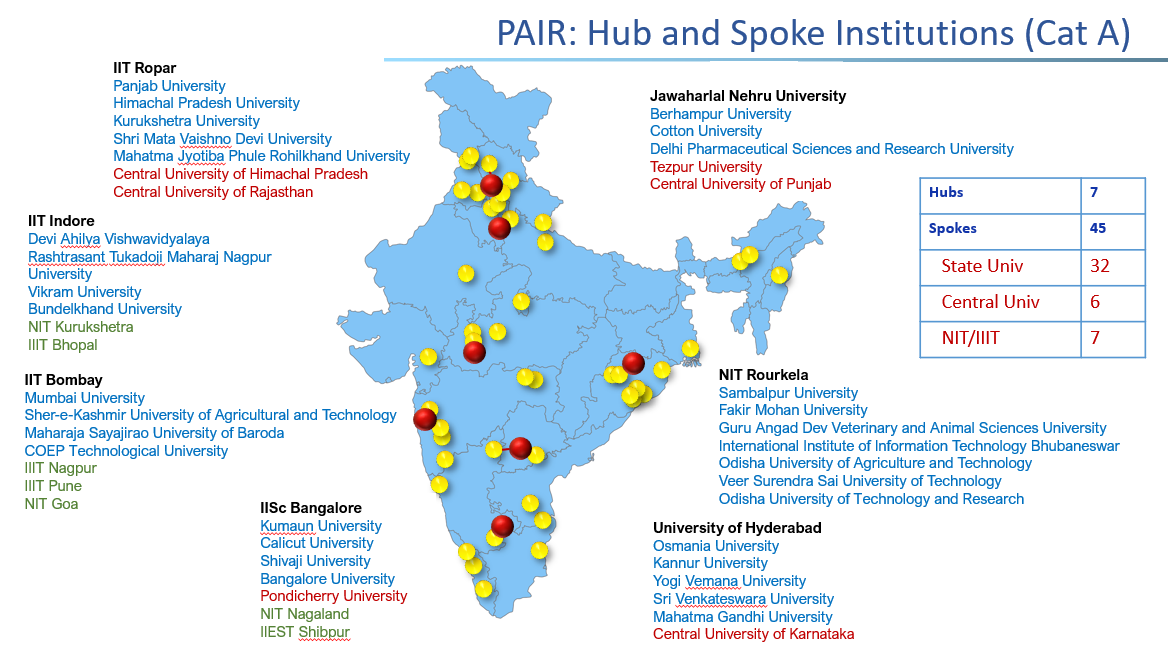
Another major class of “vertical” or focussed programs is the PAIR program, which is a hub-and-spoke approach to research capacity development and upliftment of aspiring institutions (including a large fraction of state universities) with hubs as top institutions. In the initial iteration, we have supported seven such networks including 45 spoke institutions. This is a more intensive and active capacity development driving collaboration, and with significant incentives for all parties. A map of institutions and the hub/spoke pattern is outlined in the pictures below. We will be complimenting these with PM Professorships in spoke institutions to drive mentoring and institutional development, research capacity development workshops, and technology platforms for driving collaboration, simplification / democratizing of research content for a broader set of institutions. There are also other initiatives such as One Nation One Subscription (ONOS) to help drive availability of research publications easily available for a large number of public institutions; and discussions are underway to enhance the coverage of this program in Phase 2.
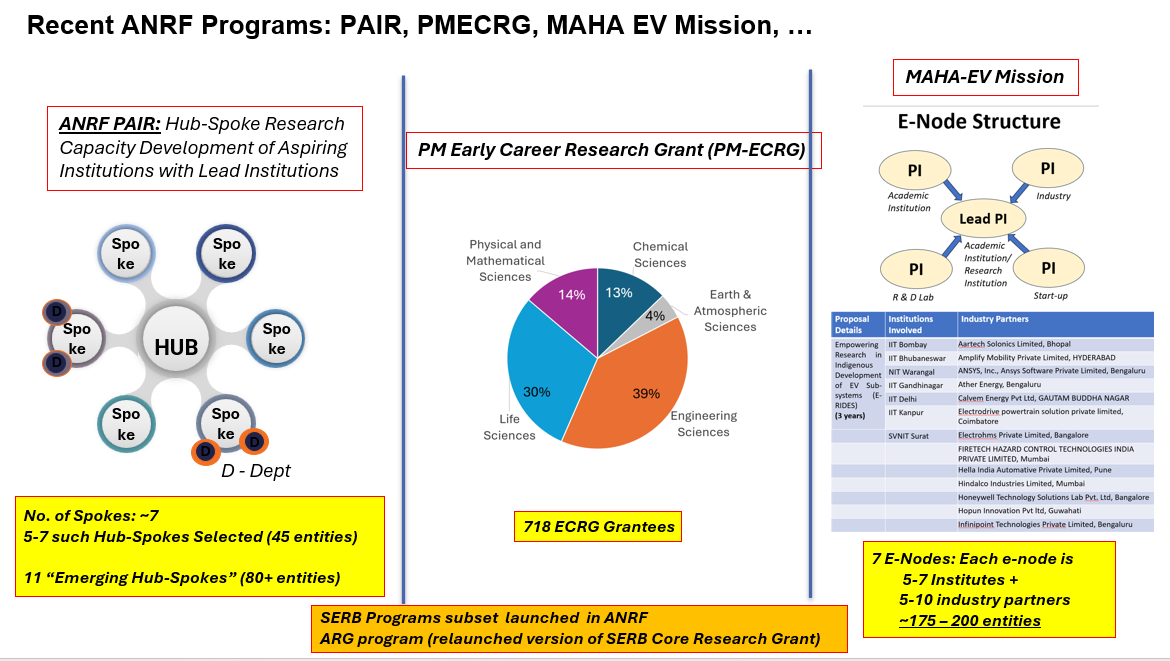
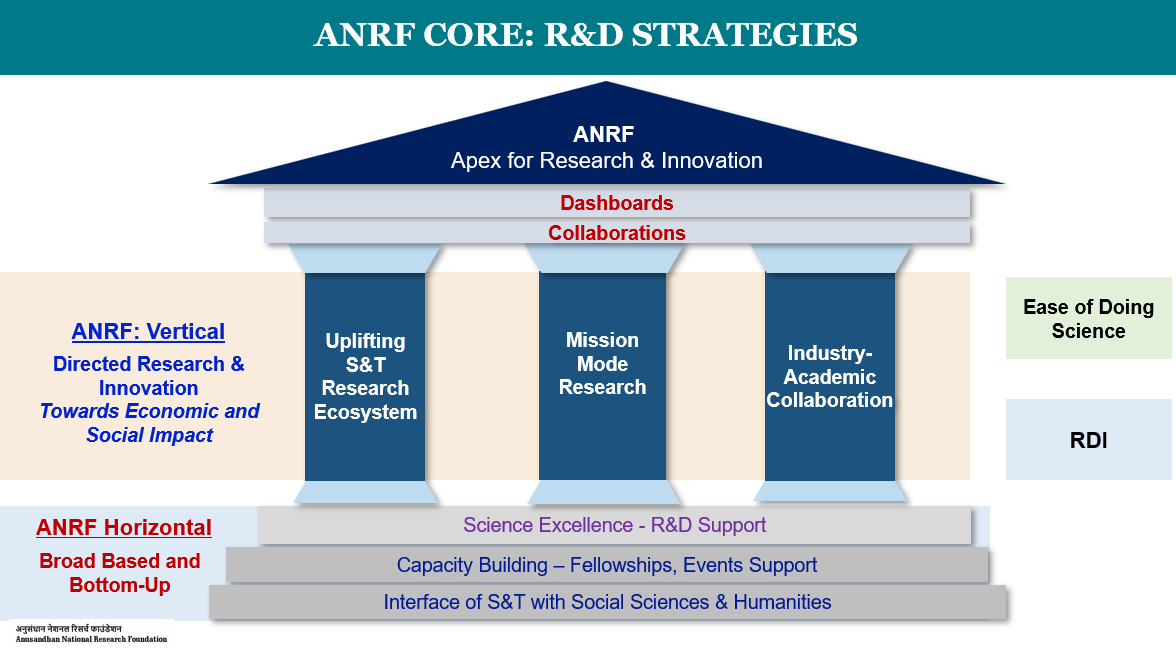
Putting it together, we may consider the grant programs strategically as helping build a “Acropolis” style building depicted below. The ANRF Horizontal programs drive science excellence, capacity building and the interface of S&T with Social Sciences and Humanities. The vertical programs are like pillars driving focus in key areas important for the economy, society, industry-academic collaboration and uplifting of the S&T research ecosystem. Finally at the top we have some selected “Apex” activities ANRF performs to drive cross stakeholder visibility, collaboration, reducing frictions, sharing best practices for collaboration.
One example of this is the SARAL AI open source project ANRF is mentoring and closely collaborating with that helps democratize, demystify and diffuse knowledge at scale across language boundaries, and converting complex primary research into “SARALified” (simplified/demystified) secondary content in different forms (videos, Reels, podcasts, presentations, posters etc) automatically via AI in 19 different languages.
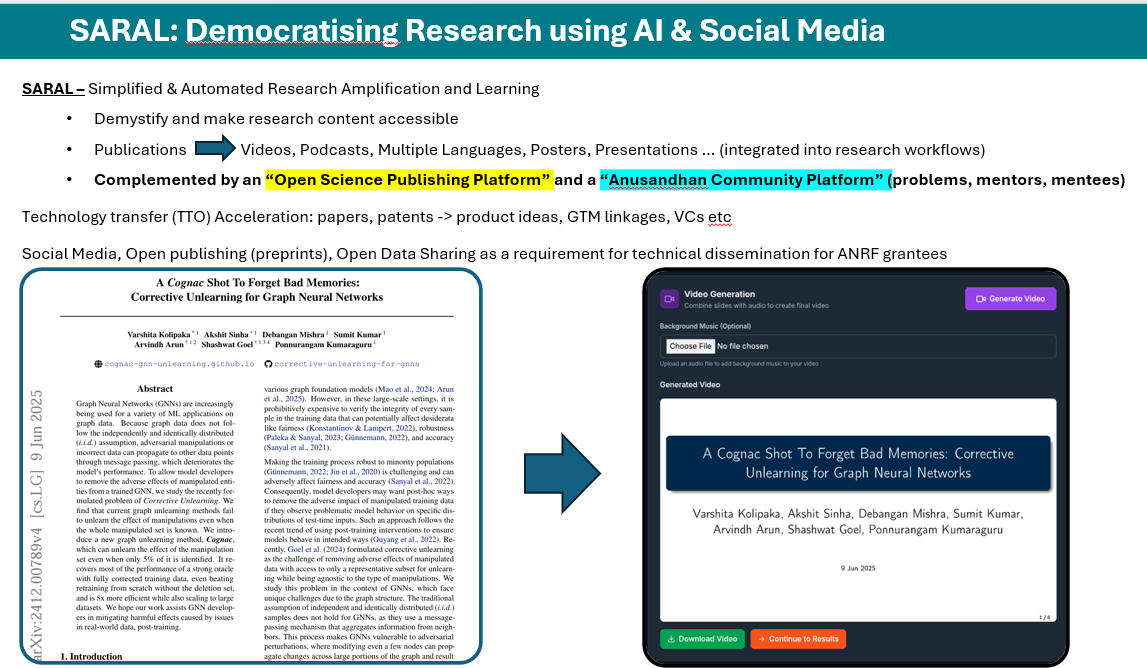
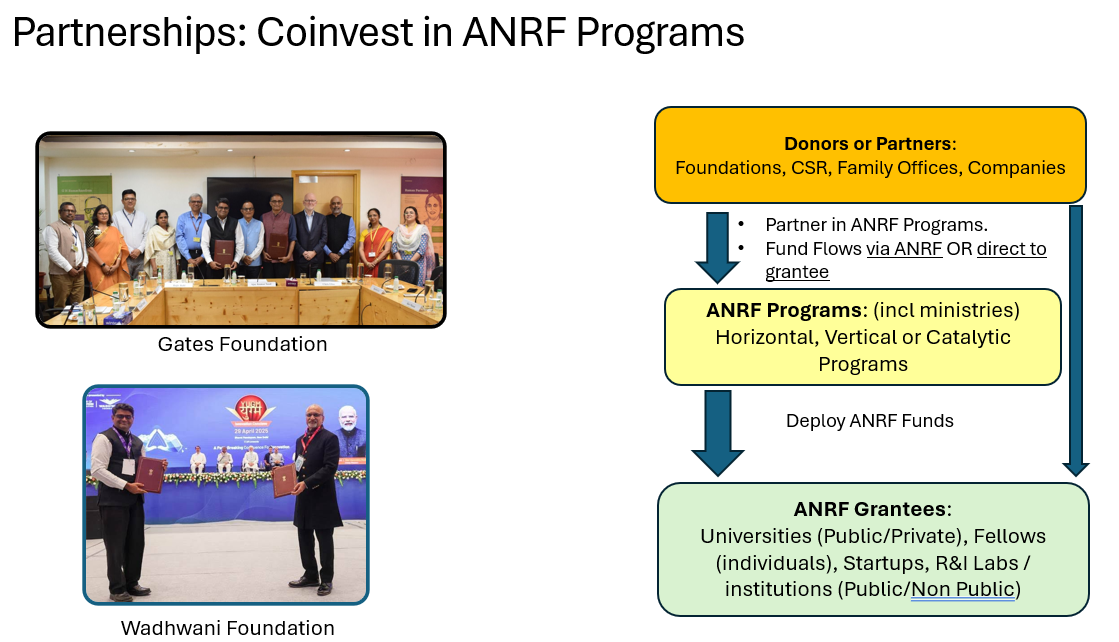
This is a first step and an inkling of many more interesting things to come using AI for the good of our research and innovation ecosystem. Finally, ANRF has been doing proof of concept of different types of non-governmental partnerships top down at scale. We have established early partnerships with Gates Foundation and Wadhwani Foundation, and have further linked these to co-investment by government partners (different departments such as DST, DBT, MEITY, MoES, DRDO, ICMR, Ministry of Mines etc). We welcome partners to co-invest (and leverage the investment of ANRF) in our grant programs.
All of ANRF programs — horizontal and vertical — will be open for co-investments, and we value the totality of what our partners bring to the table. We also have simple but consistent IP policies (IP is owned / titled by our grantees similar to Bayh-Dole approach in the USA, but grantees may make commercialization arrangements with their partners). In some areas (eg: our AI for Science & Engineering program) we have gone for a ANRF Open License model (building off a MIT license) to encourage the creation of public goods and rapid ecosystem development.
We welcome conversations with partners interested in co-investing in the foundation of Research and Innovation in India to reach out to us. We do deals quickly. Also this forms an important pipeline for RDI which allows more private sector participation at the second and third levels as discussed earlier.
ANRF is rapidly establishing such “All of Government” and “All of Society” partnerships, and invites holistic thinking by non-governmental partners, including industry, international partners and contribute to current and future ANRF Programs. My doors are open for such conversations and partnerships.
How Can an Organisation or a Person Engage w/ANRF ?
Ministry / Department or State Government: We welcome partnerships (with financial co-funding contributions) in any of our programs. Most of our MAHA mission mode programs are launched with anchor partners with one or more ministries/departments who are contributing to the outlay as well (eg: MedTech with ICMR, 2D Materials with MEITY, AI for S&E with MEITY, DRDO, MoES, DBT, CRM with Ministry of Mines, and Drones with MEITY, ICMR). If your department / ministry would like to partner with ANRF and leverage our investment in your sector using R&D, please reach out to me via your Secretary rank officer. Beyond central government, we would welcome state governments who would like to align some of their investments with our GoI central govt investments (eg: in PAIR program supporting many state universities or our mission mode programs in various sectors etc). I would request the Principal Secretary of the State Govt to please reach out to me.
Foundation / Philanthropy / CSR / Family Offices: We welcome partnerships with Foundations. As per our ANRF Act 2023ANRF welcomes contributions to ANRF programs (either current or future). As mentioned in the figure above, ANRF designs, operates programs (horizontal, vertical, or in rare cases, catalytic programs) as approved by ANRF Executive Council in national interest. We welcome ideas for new programs that we can co-design with specific partners (at scale). Partners may partner with ANRF and they have capital allocation flexibility on which programs / projects / fellowships they can contribute to. We will be adding more ways for smaller contributions. Currently we are doing larger partnerships such as what we have done with Gates Foundation, Wadhwani Foundation. You may also bottom up partner with individual grantees or consortia which bid for ANRF programs (note that in this case, ANRF is not directly involved). We also welcome collaborative philanthropy where a credible entity serves as an aggregator of individuals, family offices, company CSR or foundations. If a credible counterparty emerges, ANRF will be open to partnering (and the contributions will get leverage because of the investments ANRF & GoI are making in specific sectors or programs).
Startup / MSME: Please await the formation of RDI SLFMs (second level fund managers). This will lead to a lot of financial intermediaries and capital of different forms (soft loans, vanilla loans, OCDs, equity etc). We expect startups to be big beneficiaries of the RDI fund and its multiplier effect in capital formation. On grants, please partner with any of academia / national labs / section 8 entities appropriately in proposals to ANRF. While we may (on the short term) not be able to send grant money to these entities (till we raise more capital), most of our MAHA mission mode programs welcome partnerships. In our AI for Science & Engineering program we also have an ANRF Open License (based upon MIT license).
Industry (larger) / GCCs / Industry Associations : Please await the formation of RDI SLFMs (second level fund managers). This will lead to a lot of financial intermediaries and capital of different forms (soft loans, vanilla loans, OCDs, equity etc). Industry / GCCs could also be limited partners in SLFMs, but with conflict of interest clearly declared. Our grant programs do not currently send money to industry with rare exceptions like MAHA MedTech programs. In the future we may consider ANRF special purpose funds in partnership with specific ministries (or individual ministries may run programs directly). Please also participate in consortiums led by academia / national research labs / section 8s. National research labs will be increasingly be doing more co-development and other PPP models which ANRF may choose to catalyze. For competitiveness in RDI, you are strongly encouraged to partner with academia, labs, section 8s in the backend. If you want major new MAHA mission mode programs, please come and partner top-down with ANRF (either directly or a consortium or with an appropriate industry association.
Scientists / Professors / Industry Folks / Administrators interested in ANRF positions and contributing for a fixed term or long term: ANRF is hiring at different levels:
- Scientist C, D … and deputation for Scientist G; and administrative positions: More details here. And advertisements here and here
- Experts at various levels … 2 – 3 year appointments in ANRF. More details here.
Committed Volunteering: We are considering a model for committed volunteers (real commitment, no pay, not a formal appointment). If you are interested, please contact Atul Batra and/or Amol Khire who are helping me organize this.
Connect with ANRF: ANRF is now on many social media platforms and quite active. We will be expanding soon to Whatsapp and Arattai. In the meantime, please follow / subscribe to ANRF in these channels. We also have channels specific for individual programs in Linkedin. Join / connect with ANRF on these social media:
- 𝗟𝗶𝗻𝗸𝗲𝗱𝗜𝗻: https://www.linkedin.com/in/anrfindia/
- (𝗧𝘄𝗶𝘁𝘁𝗲𝗿): https://x.com/ANRFIndia
- 𝗙𝗮𝗰𝗲𝗯𝗼𝗼𝗸: https://lnkd.in/gkBtnbMK
- 𝗬𝗼𝘂𝗧𝘂𝗯𝗲: https://lnkd.in/gWYijzek
- 𝗜𝗻𝘀𝘁𝗮𝗴𝗿𝗮𝗺: https://lnkd.in/gXK_-WP3
- Use hashtag #ANRFIndia for tagging.