Molecular geneticist Pallavi Kshetrapal, Associate Professor at BRIC-THSTI, traces her scientific journey from curiosity-driven beginnings to mentoring and leadership. Reflecting on the inaugural Young Investigators’ Meeting (YIM) 2009, she highlights how mentorship, collaboration, and authentic science shaped her career and continue to strengthen India’s research ecosystem.

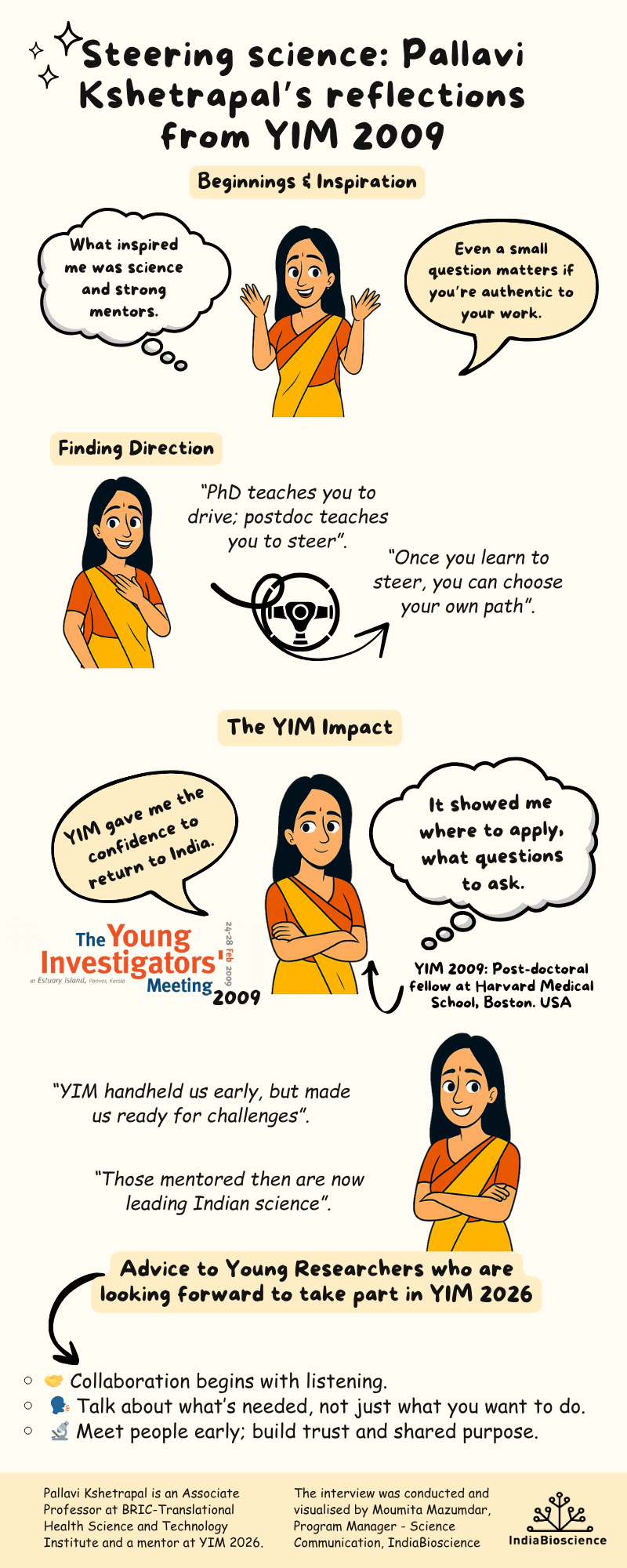
Pallavi Kshetrapal is a molecular geneticist and an Associate Professor at BRIC-Translational Health Science and Technology Institute. She recalls the beginnings of her scientific journey, attributing her career path to both curiosity and the mentors she met. “When I started my PhD at CSIR-CCMB, I realised there were deeper biological questions about understanding phenomena, who we are, and how we are made, that I wanted to explore.” Pallavi emphasises that rigorous, ethical, and authentic science lays the foundation for a strong research career.
As scientists, we have to ground our experiments in logic and evidence. Even when you’re working on a small part of a bigger question, the integrity you bring to it builds trust, and that commitment carries you through your postdoc and beyond.”
YIM has played a pivotal role in shaping Pallavi’s postdoc trajectory and the eventual decision to return to India. Reflecting on YIM 2009, which was also the inaugural YIM, she says, “It gave me a basis for how to apply in India, what questions could be answered here, and where to seek funding. We met mentors like Shubha Tole, L.S. Shashidhara, Ron Vale, and Anuradha Lohia who told us about critical areas of research, and the ways we can contribute meaningfully”.
Pallavi emphasises the long-term value of collaboration and networking. “Collaborations are key. You should seek them early, look for technical and scientific compatibility, and be open to multidisciplinary approaches. Be a good listener and understand others’ perspectives. Give time to build trust, networking early shortens the path to success”. She stresses that communication is central to these collaborations. “You need to understand their language. If you go to a clinical or immunology group, you can’t just talk about basic biology; you need to present what your work implies in a way they understand. A clinician should grasp your idea in a minute”.
Looking back, Pallavi credits YIM for providing mentorship at a crucial juncture. “YIM handheld us in the beginning. They were honest about the struggles you’d face, the competitive environments, and the challenges of returning to India, but they also gave us a safety net. We learned to persevere, stay authentic, and network effectively”. She reflects with pride on the trajectory of those who attended YIM alongside her: “The senior researchers who attended then are now directors at different institutions. It’s heartening to see that the mentorship we received has shaped India’s scientific leadership”.
For young scientists, Pallavi’s advice is clear: seek collaboration, respect all stakeholders, and cultivate networks early.
You can struggle together, generate good ideas, and establish meaningful partnerships. That’s the way to accelerate your career. And always keep the long-term vision in mind: mentorship, collaboration, and authentic science are what steer you towards leadership”.
Through Pallavi’s reflections, it becomes evident how mentorship programmes like YIM not only guide scientific careers but also build the collaborative and visionary leadership necessary for India’s research ecosystem.