Mayurika Lahiri, Associate Professor at the Indian Institute of Science Education and Research (IISER) Pune, reflects on her long association with the Young Investigators’ Meeting (YIM) in this conversation with us. She attended the inaugural edition in 2009 after returning from her postdoctoral fellowship in the US, participated again as a YIM alumnus in 2019, and will return as a mentor at YIM 2026.

Having seen the meeting both as a young investigator and now as a senior mentor, she shares how YIM has changed in format but has stayed true to its core values of community, mentorship, and collaboration. She speaks about the networks she built in her early years, the lessons in empathy and leadership she hopes to pass on, and how YIM creates a sense of belonging for young researchers navigating the uncertainties of academia.
1. How has your YIM experience evolved over the years?
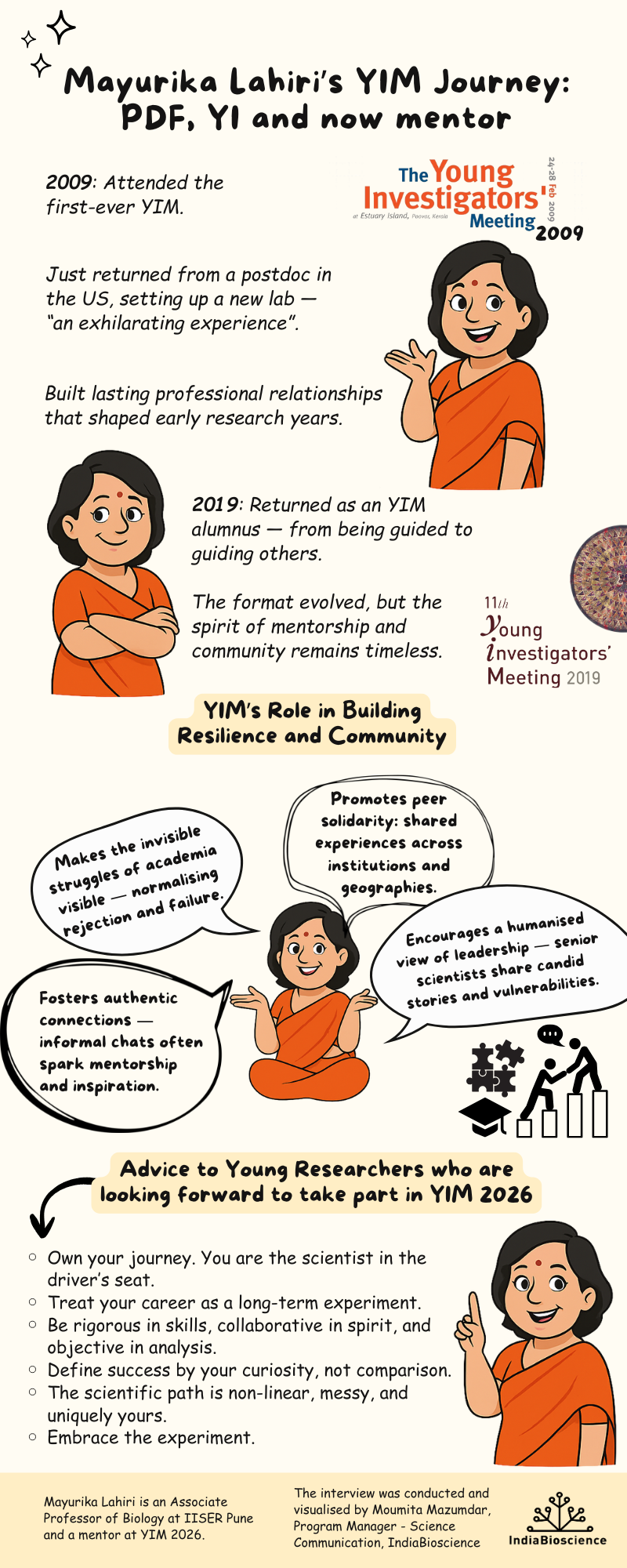
Attending the first YIM in 2009 was memorable since it was the first meeting of its kind in India. It gave me a chance to meet researchers across the country, many of whom I am still connected with. I had just returned from my postdoctoral work in the US and was setting up my laboratory, so the experience was exciting and energising. A decade later, returning to YIM 2019 felt very different. By then, I had spent almost ten years establishing my research programme. I was no longer a young investigator in the same sense and could enjoy the meeting from a mentoring perspective. It was fulfilling to guide others who were setting up their labs. Over the years, the meeting has evolved, but the spirit of openness, support, and community has remained exactly the same
2. As a YI in 2009, what were the key takeaways or connections that shaped your academic journey at that stage?
Since I had not done research in India (I left right after my BSc), the 2009 YIM helped me connect with established researchers in the country. These early connections grew into long-term networks that would have been difficult to build otherwise. IISER Pune was also very young at the time, so advice on administrative processes, sharing of reagents, and early collaborations were incredibly helpful. These relationships made my transition into the Indian research ecosystem much smoother
3. Coming back as a mentor in YIM 2026, what will be most important for you to share with the next generation of scientists?
(i) Build networks with your peers. These relationships will support you throughout your career.
(ii) Lead with empathy and inclusivity. A lab thrives when every member feels safe, respected, and motivated.
(iii) Collaborate meaningfully. Complex research questions cannot be solved alone; they will benefit from multiple perspectives and shared expertise.
4. From your perspective, how does YIM help build resilience and community among early-career researchers in India?
Academia is competitive, and failure often feels personal and isolating. At YIM, early-career researchers realise they are not alone. When a senior scientist or Nobel Laureate talks openly about a rejected grant, a failed experiment, or a setback in their career, it breaks the myth of the “perfect” scientific journey. It helps ECRs see struggle as a normal part of the process, not a personal flaw. This shift is central to building resilience.
YIM also creates a strong peer community. An ECR from a small university might meet someone from a premier institute and discover they face similar challenges, whether with resources, administrative hurdles, or work-life balance. These connections often become long-term collaborations and friendships. When a paper is rejected or an experiment fails, there is a community that understands and supports them.
Informal interactions over meals, poster sessions, or during breaks also play a big role. Seeing senior scientists as approachable, everyday people breaks psychological barriers. It shows ECRs that leadership roles are attainable and encourages them to imagine themselves in those positions one day. This sense of community, belonging, and shared experience is what makes YIM special.
5. Looking back, what advice would you give to today’s Young Investigators, especially those facing uncertainties in academia?
I would say that the uncertainty is real, but they are not passive travellers.
They are in the driver’s seat. Think of the career as the most important long-term experiment. Build skills with intention, collaborate generously, and don’t take failure personally. Let curiosity guide one’s choices and define what success means to them. The journey will be messy and non-linear, but it is theirs to shape. They should embrace it like any good experiment, with openness, patience, and confidence in the process.